Free trial Sign in
  1. Question time

    Rillington Railway Station

    The framework for a one-place study is based on the outcomes you would like to see – this may well change as the study progresses! There is no prescriptive way of assembling a one-place study as every place is different and your interests will be equally varied.

    Your place also needs to be viewed in a wider context as no community exists in isolation. For example, the parliamentary enclosure acts changed the rural landscape from open fields and common pastures to consolidated fields which were individually owned or rented.

    A good place to start is by asking yourself questions about your place:

    • People – Who lived in your community? Who were the principal residents? How did they shape village life? Who owned land and who rented? Who were the gentry? Were they armigerous?
    • Topography – What are the unique features of your place? Did topography affect, limit or attract developing industry? Chalk hills, river, coal seams.
    • Population – What caused an increase and/or a decrease in population? Who emigrated and immigrated and why?
    • Occupations – What were typical trades and occupations for the inhabitants? Linen, brick-making, agriculture? Did this change over time and why?
    • Poor relief – What provision was made for the poor? Was there a workhouse? Were there any Friendly Societies – Foresters, Shepherds, Druids, Gardeners, Sons of Temperance, Rechabites?
    • Housing – What were the houses like? Are there any old photographs, drawings, sketches or postcards available?
    • Nonconformity– Was your place a hotbed of nonconformity? Methodists, Quakers, Jews, Baptists, Huguenots? What did these groups bring to your place? Temperance? Sunday schools?
    • Governance – How was your place managed? Who were the members of the vestry or manorial court and what was their influence? Who were the incumbents?
    • Education – Was there a dame school or village school? Was there regular attendance? Were there any famous scholars?
    • Transport – Were there roads or canals? How did the coming of the railways affect your place? How has transport changed?
    • Crime – Who were the perpetrators and how were they punished? Did anyone get transported? How were crimes recorded?
    • Militia – Was there a local militia? If so what happened after the Militia Act in 1757?
    • Death – Were there any significant diseases? Infant mortality? Felo de se? What was life expectancy through time?

    Once you decide on your preferred outcomes, then the appropriate records and maps can be researched and recorded. What questions will you ask yourself about your one-place study? Where will your journey take you?
  2. Every last drop

    Family Historians are familiar with squeezing out every possible fact from primary evidence such civil registration certificates and wills. Any extra information gleaned is a bonus and can extend a pedigree by providing, say with a birth certificate, such information as the mother’s maiden surname. Equally, a marriage certificate may identify the name of the father of the bride and groom along with witnesses and of course a death certificate should state not only who registered the death but also the cause. Finally, if you’re fortunate and can locate a will, then sometimes up to three generations can be mentioned as beneficiaries in a will as well as bequests made to favoured servants and friends.

    Examination of records for a one-place study are conducted with a slightly different outlook. Whilst scrutinising a community as a whole, people can be discovered where you’d least expect. Always be on the look out to uncover the unexpected.

    Instead of searching for the name of a person in the online catalogue of a local archives, diocesan record office or specialist repository, an alternative search should be focussed on the place.

    A plethora of records will become apparent which may not have been considered when looking for a person:

    • Board of Education returns
    • Private lunatic asylums
    • Ordnance survey sheets
    • Lease and release
    • Bargain and sale
    • Friendly Society records
    • Glebe terriers

    … and many more.

    Although the emphasis shifts from tracing ancestors to witnessing the development of a community, these records can provide evidence that places an individual in a specific time and a place which may not have been apparent from the census 1841-1911.

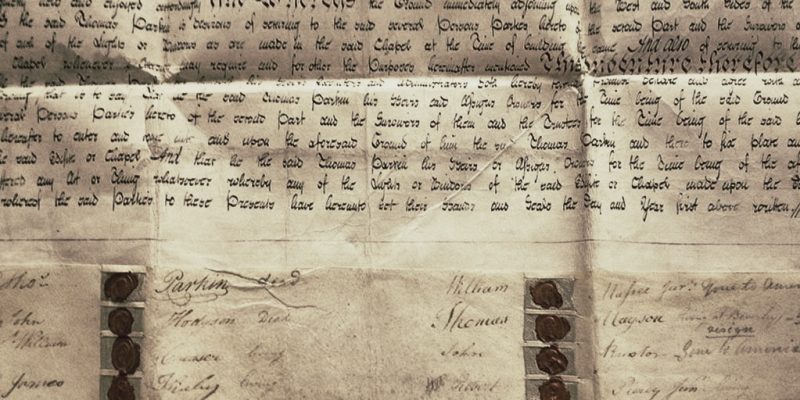
    The deed in the above photograph records the parties named in the purchase of land for a Methodist chapel in 1803. The signatures of the trustees are recorded at the bottom of the page along with their seals. By the time the trustees were updated, a note explained the current status of the signatories i.e. deceased, resigned and gone to America.

    By using Name & Place you can import the document image and record the details of some of the members of the Methodist congregation. You can identify the parties and who were trustees thus narrowing down the date of their death and emigration, building an holistic overview of a small section of the village, land earmarked for building and inhabitants who were nonconformists.

    By encompassing all record types in its data repository, with full indexing, Name & Place enables matches to be found in more obscure documents. Using its full search capabilities, you can manually locate based on person or place names but we’re also employing intelligent matching to try to suggest possible connections you may not have noticed across all datasets.

  3. Gathering resources

    Family Historians study the biography of an ancestor using records of birth, marriage, death, census and wills to compile a pedigree.

    A One-Place Study however, looks holistically at a place that may or may not include researching a particular family. These traditional family history records are made all the more enjoyable by producing outcomes such as population statistics and establishing why people migrated in and out of the village. Occupational trends highlight why some trades flourished and others declined. Family and local history research working alongside each other, constitutes a more complete analysis.

    House history includes property deeds – the scope of the land and property, architecture and usage together with the names of the owners over many years. Legislation such as the Hearth Tax, Land Tax and Window Tax generated additional records for consideration.

    Vestry meetings were like a local parliament and if records are available, they can contain such fascinating details such as who paid into the parish rates and who received poor relief.

    Maps are invaluable for illustrating the development of a community and its evolving topography through time. Enclosure, tithe and OS maps supported by the use of old postcards and photographs can help identify the likely time a building was erected, extended and demolished. Comparing old and current postcards is a brilliant game of ‘spot the difference’ over the decades.

    Newspaper articles and parish magazines are a wonderful resource to better understand the day-to-day life of a community, the former including all the scandal.

    Oral history captures memories and reminiscences from living inhabitants.

    Researchers often need to tackle a section of work in bite-sized chunks to avoid becoming overwhelmed by all the information. So, if the question is “How can I manage my vast and varied One-Place or One-Name Study data?” Name & Place is the answer.