Free trial Sign in
  1. Name & Place releases version 1.1


    The release of v. 1.1 on 3 June 2020 has been a twinkle of joy during the enduring challenges for us all in the midst of the COVID-19 pandemic. When we launched Name & Place at RootsTech in February, who could have predicted how massively our way of life would be altered. We have all now become part of recorded history by living through and experiencing such major societal upheaval and change.

    So, with v. 1.1, we have created three major new features:

    • A promotional website for each of your projects
    • A spreadsheet (CSV) importer with structured templates for importing census and other data
    • Unique identifiers for each name and place

    We have introduced and refined many aspects of Name & Place, some will be obvious and some more subtle behind the scene elements. Detailed blogs will follow on each feature, however in the meantime, if you have any technical queries or constructive feedback, please contact us direct by email at support@nameandplace.com we’d love to hear from you.

  2. Name & Place launches at RootsTech, Salt Lake City

    RootsTech Salt Lake City

    Name & Place at RootsTech, Salt Lake City, February 2020

    Wednesday, 26th Feb 2020 saw the launch of Name & Place, the innovative cloud database and mapping software. It was perhaps befitting that the launch took place in Salt Lake City, Utah where RootsTech, the world’s largest family history event was meeting to celebrate its tenth anniversary.

    Name & Place, developed by Paul Carter, meets a need to manage research projects with a scope outside of traditional family history; the One-Place Study , One-Name Study, Local History Project or House History.

    In contrast to the key assumption shared by family tree software, that the research subjects are related through birth or marriage, Name & Place empowers the researcher to define the scope of their project, whether the people simply lived, worked or were buried in the same place or just shared a common surname. A spreadsheet, the typical alternative explored by such researchers, lends itself well to structured data entry but fails quickly when attempting to layer multiple datasets and analyse results.

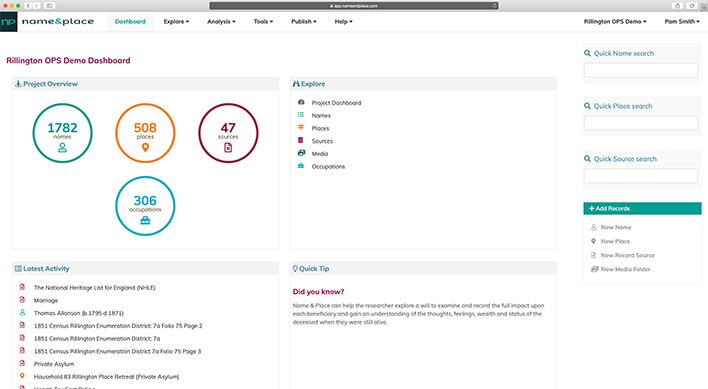
    Name & Place’s unique ability to integrate names, places and sources through record linkage opens up a world of examining research data at a holistic level before drilling down to each event or fact. Names and places interact, through the source record, the common glue of research. Each name, place, event and fact may be captured, and the individual records automatically updated.

    By defining a location for each place within the project, powerful mapping analysis becomes possible, tracking migration patterns or population changes throughout your research. Layer photographs and documents, linked to a name, place or source, and your project comes to life with colour and context. As a cloud-based solution, each Name & Place project comes with a dedicated web page, enabling you to promote your project to the online world with the aim of interacting with interested parties.

    Your project’s scope is constrained solely by your requirements. Research of a graveyard or war memorial is as managed equally as well as a ship history, a DNA study or a worldwide surname project. Whatever the focus of your project, you will find Name & Place intuitive, powerful and above all, specifically designed to fit your research needs.

    See how Name & Place can help your research. A free two-week evaluation copy is available when you register at www.nameandplace.com.
  3. Question time

    Rillington Railway Station

    The framework for a one-place study is based on the outcomes you would like to see – this may well change as the study progresses! There is no prescriptive way of assembling a one-place study as every place is different and your interests will be equally varied.

    Your place also needs to be viewed in a wider context as no community exists in isolation. For example, the parliamentary enclosure acts changed the rural landscape from open fields and common pastures to consolidated fields which were individually owned or rented.

    A good place to start is by asking yourself questions about your place:

    • People – Who lived in your community? Who were the principal residents? How did they shape village life? Who owned land and who rented? Who were the gentry? Were they armigerous?
    • Topography – What are the unique features of your place? Did topography affect, limit or attract developing industry? Chalk hills, river, coal seams.
    • Population – What caused an increase and/or a decrease in population? Who emigrated and immigrated and why?
    • Occupations – What were typical trades and occupations for the inhabitants? Linen, brick-making, agriculture? Did this change over time and why?
    • Poor relief – What provision was made for the poor? Was there a workhouse? Were there any Friendly Societies – Foresters, Shepherds, Druids, Gardeners, Sons of Temperance, Rechabites?
    • Housing – What were the houses like? Are there any old photographs, drawings, sketches or postcards available?
    • Nonconformity– Was your place a hotbed of nonconformity? Methodists, Quakers, Jews, Baptists, Huguenots? What did these groups bring to your place? Temperance? Sunday schools?
    • Governance – How was your place managed? Who were the members of the vestry or manorial court and what was their influence? Who were the incumbents?
    • Education – Was there a dame school or village school? Was there regular attendance? Were there any famous scholars?
    • Transport – Were there roads or canals? How did the coming of the railways affect your place? How has transport changed?
    • Crime – Who were the perpetrators and how were they punished? Did anyone get transported? How were crimes recorded?
    • Militia – Was there a local militia? If so what happened after the Militia Act in 1757?
    • Death – Were there any significant diseases? Infant mortality? Felo de se? What was life expectancy through time?

    Once you decide on your preferred outcomes, then the appropriate records and maps can be researched and recorded. What questions will you ask yourself about your one-place study? Where will your journey take you?